
Which San Jose Records Are Open
California treats a public record as a writing about public business that a state or local agency prepares, owns, uses, or keeps. The format does not control access. The California Public Records Act, Gov. Code § 7920.000 et seq., favors inspection, yet an express exemption or a stronger public interest in nondisclosure may support withholding. An agency must still release reasonably separable, nonexempt parts. San Jose researchers therefore need both the record set and its access level.
| San Jose record set | Keeper | Digital starting point | Practical access |
|---|---|---|---|
| Deeds, liens, and maps | Santa Clara County Clerk-Recorder | Self-Service index | Index online; real-estate viewing and research in person; copies in person, by email, or mail |
| Parcel and assessment facts | Santa Clara County Assessor | Real Property Search | Free address, APN, or map search; no online owner-name search or display |
| Property tax | Department of Tax and Collections | Secured tax lookup | Search by APN or address |
| State trial cases | Santa Clara Superior Court | Public Portal | Online index where available; terminals, microfiche, and clerk copies fill gaps |
| Birth, death, and marriage | County Clerk-Recorder, local registrar, or CDPH | No general county vital index | Request an authorized or informational copy under California rules |
| Police and custody records | Sheriff, SJPD, CDCR, or DOJ | Agency-specific lookup or request | Current custody data may be searchable; reports are reviewed and may be redacted |
| Historical county files | Santa Clara County Archives | Online database indexes | Index online; documents require Archives follow-up |
Open does not mean unrestricted. Sealed court cases, juvenile and adoption matters, confidential family records, protected voter details, DMV personal data, and parts of vital records remain closed or limited. Even a public index may reveal less than the underlying file. That split shapes nearly every San Jose records request.
San Jose Public Records Custodians
Most local records belong to one of four keepers. The Clerk-Recorder handles recorded instruments and county vital copies. The Assessor connects an address to parcel and document data. Superior Court controls state case files. City departments answer requests for San Jose agency business through the city records system. Contact the office that created the item, not simply the nearest government counter.
County Clerk-Recorder
110 W. Tasman Dr., 1st Floor
San Jose, CA 95134
408-299-5688
Counter schedules differ. The Assessor lists weekday hours from 8:00 a.m. to 5:00 p.m. Superior Court buildings use those hours too, but clerk service ends earlier. Confirm current access before making a trip.
San Jose Recorder Search Limits
The recorder trail holds deeds, deeds of trust, statutory liens, abstracts of judgment, and maps. Its most important local limit is easy to miss: the Clerk-Recorder says a property address and Assessor's Parcel Number cannot be searched in its index. Real-estate documents must be researched and viewed in person, and staff do not conduct title searches. Digital Reel reaches maps and documents from 1850 through 1980.
| Recorder field | Input type | Required? | San Jose search note |
|---|---|---|---|
| Name | Text | Optional | Use grantor, grantee, or party names and try spelling variants |
| Document number | Text | Optional | Best route when an Assessor result or prior deed supplies the number |
| Book and page | Text pair | Optional | Useful for maps or documents recorded before 1994 |
| Address | Not accepted | Not applicable | Search the Assessor first |
| APN | Not accepted | Not applicable | Search the Assessor first |
| Digital Reel | Browse or search | Optional | Maps and documents from 1850 through 1980 |
The Clerk-Recorder official-records hub shows the public gateway used for index and copy work.
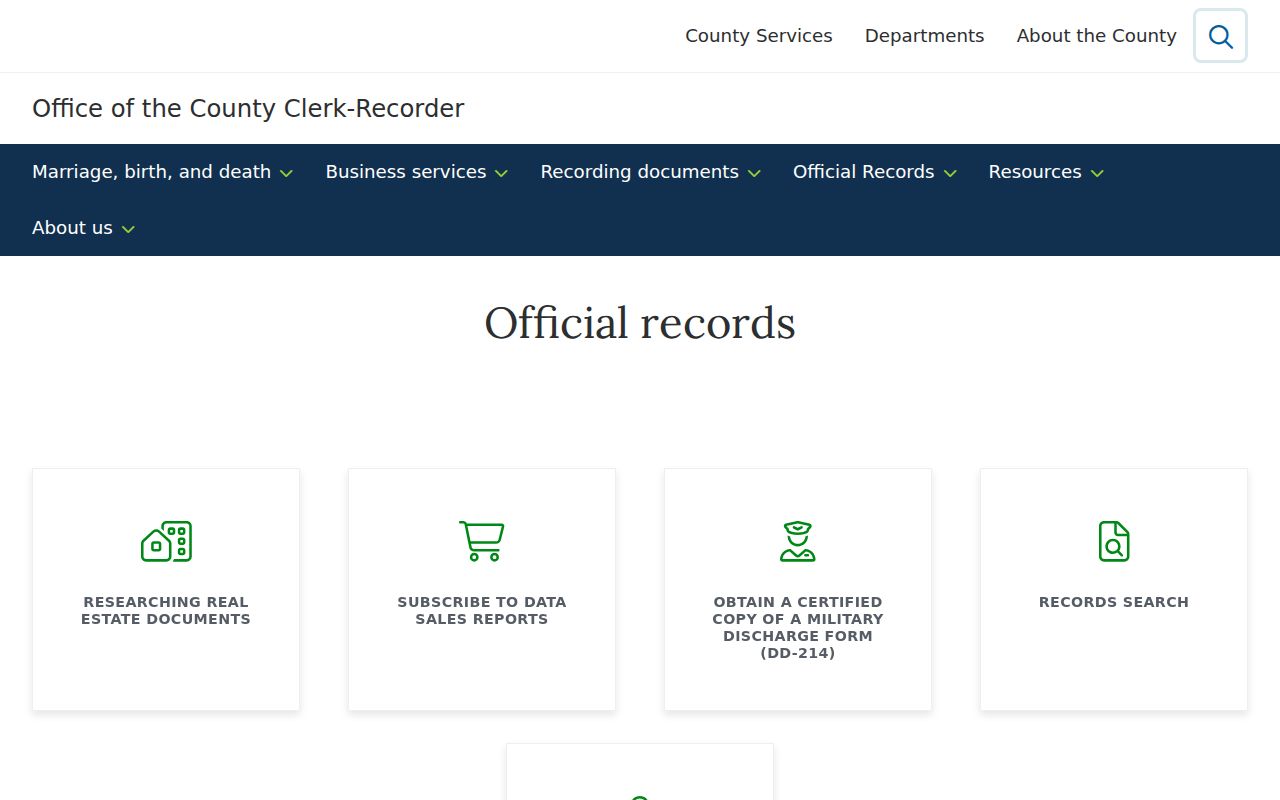
The captured page reinforces that recorded documents, maps, forms, copies, and fees belong to one county records system, while the actual research channel depends on the item.
- Index
- A list of record references and key fields. It may not include the full document image.
- Certified copy
- A copy authenticated by the custodian. It is different from a plain photocopy.
- Custodian
- The agency or office responsible for keeping and releasing a record.
- Exemption
- A legal basis that allows or requires an agency to withhold information.
Bridge San Jose Property Records
Use the Assessor before the Recorder when the starting fact is an address or APN. The county's free property search accepts the first few address characters, a parcel number, a map location, or a separate mobile-home query. Results may show the APN, situs address, mailing address, assessed value, document number, and parcel map. A situs address is the physical property location; a mailing address is where tax or ownership mail goes.
This creates a precise chain: address to Assessor record, Assessor document number to recorder index, then recorder index to the in-person image or ordered copy. The online Assessor omits individual owner names and does not offer an owner-name search. That is not a failed result. It is a deliberate access boundary, while sales-transfer lists available from the office can include buyer, seller, dates, and document numbers.
The DTAC secured property-tax page illustrates the separate tax channel for address or APN research.
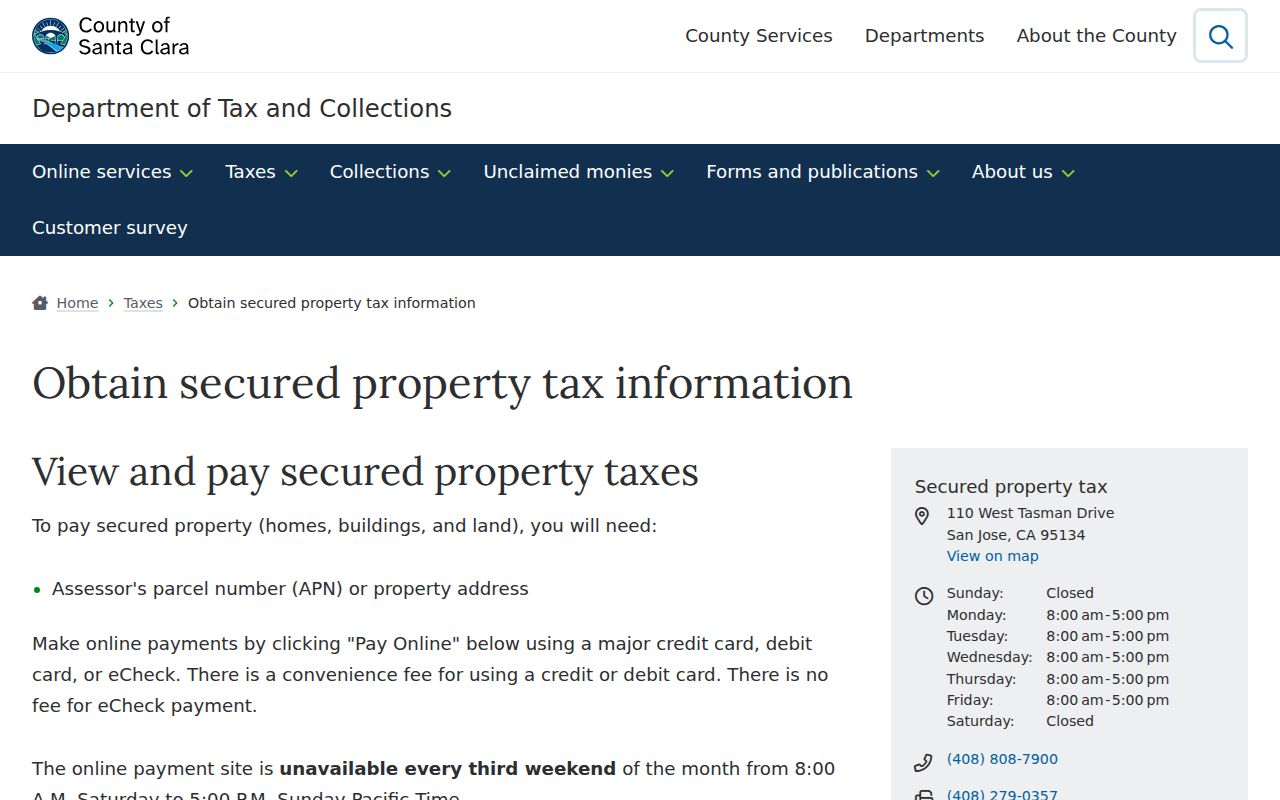
Tax bills add account context, while Property Explorer supplies parcel boundaries, zoning, and property characteristics. Neither replaces the recorded deed.
Local shortcut. An address cannot go straight into the recorder index. Let the Assessor expose the APN or document number, then move to the Clerk-Recorder.
San Jose Court Records Layers
Santa Clara Superior Court separates an online case index from the case file. The portal covers civil, small claims, probate, some family, traffic or local ordinance, and criminal matters. Criminal online coverage begins with cases filed in 2004. A criminal index query can use a defendant name with date of birth, or a defendant name with the filing month and year. A case number is the strongest key for copies.
Older criminal index work moves to courthouse microfiche. Available files can also be viewed on public-access terminals, and clerk copies cost $0.50 per page before added certification or search fees. A mail request should give the case number, full party names, document titles, filing dates if known, a self-addressed stamped envelope, and payment. Adoption, juvenile, mental-health, sealed, and other confidential matters do not become open merely because the portal has a broad case category.
The court's Case Information Online page distinguishes online entries from courthouse viewing and copy service.
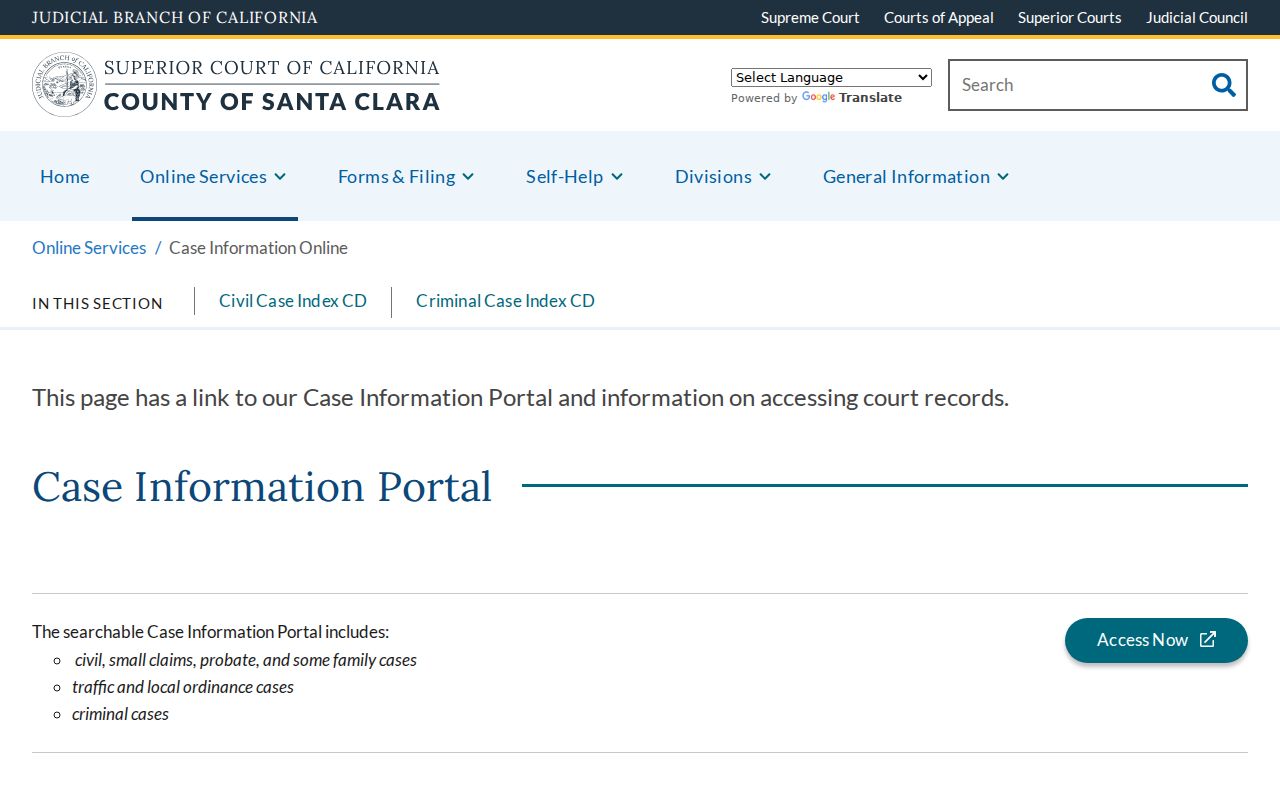
The image is a starting point, not proof that every pleading or exhibit can be opened from home.
San Jose Vital Records Copies
Santa Clara County does not offer a general online birth, death, or marriage search. A requester must know enough event detail to order a copy from the County Clerk-Recorder, a local registrar, or California Department of Public Health Vital Records. County applications may be sent by mail or placed online through the county's vendor, with completed requests mailed in four to six weeks.
California distinguishes an authorized certified copy from an informational certified copy. An authorized copy can establish identity and is limited to people allowed by Health and Safety Code §§ 103525-103526, with the required sworn and notarized identity statement or electronic verification. An informational copy cannot establish identity. Confidential marriages stay with the county and generally are available only to the named spouses unless another rule authorizes release.
The official Health and Safety Code § 103526 page displays the authorized-person rule behind that access split.
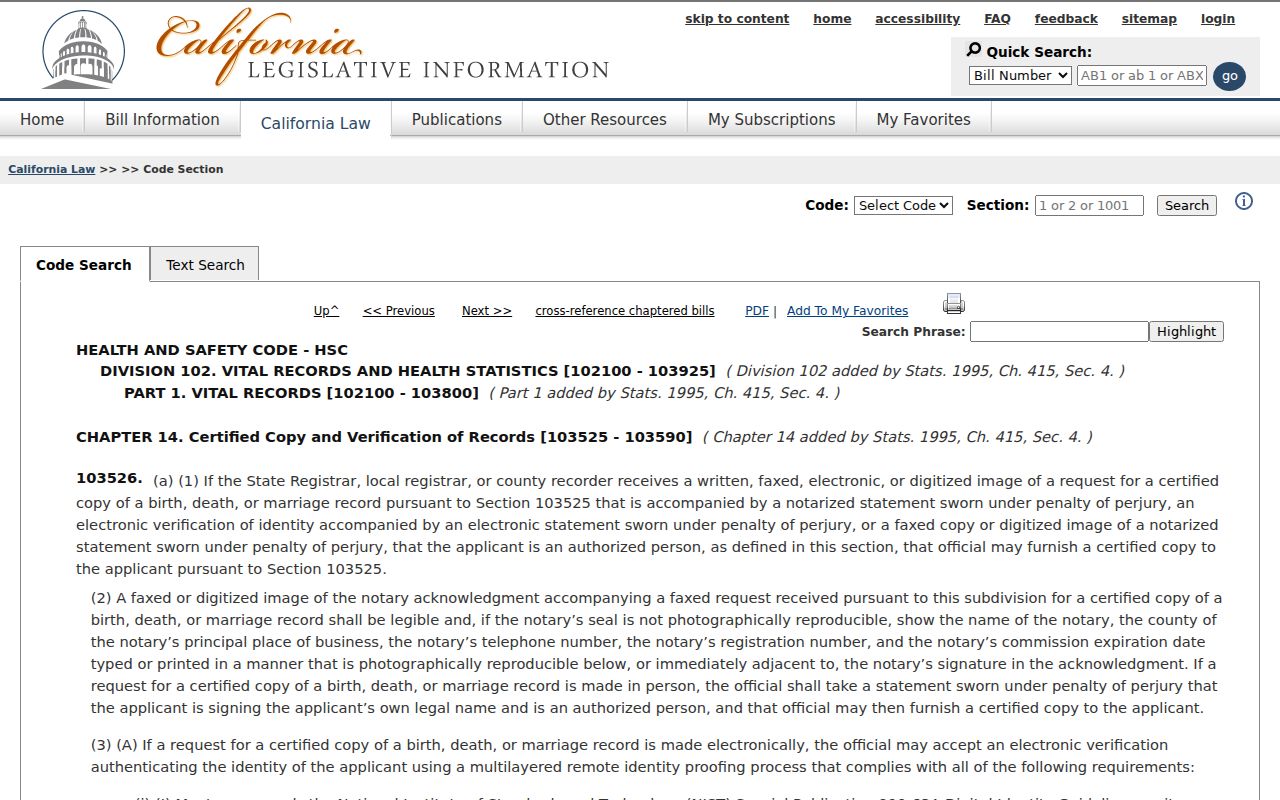
The statute view helps explain why paying a fee alone does not grant every requester an identity-valid certificate.
San Jose Safety Records Boundaries
The Santa Clara County Sheriff inmate search is a current-custody tool, not a complete criminal-history database. It accepts first and last name with birth date, a Personal File Number, or a booking number. Results can show booking number, name, birth date, race, sex, commit date, arresting agency, and custody status. CDCR's CIRIS serves the current state-prison population, while federal custody uses a separate federal locator.
Sheriff reports require a records request and review. The Records Division accepts anonymous public requests, offers an appointment-based counter at 55 W. Younger Ave., and may redact material tied to witness safety, active investigations, or protected information. San Jose Police incident reports can be requested online, in person, or by mail; sensitive reports use the mail or counter channels.
The Santa Clara County inmate portal shows the narrow custody-focused search surface.
A matching custody result should not be read as a full case history, conviction record, or current address outside custody.
San Jose Public Records Costs
Fees follow the record and delivery channel. Clerk-Recorder plain copies cost $4 for the first page and $2 for each added page; certification adds $2 per document. Email requests still produce a physical mailing and carry a $6 card-processing fee, while an in-person card payment carries a $2.50 processing fee. Mail and email orders need enough document detail for staff to identify the copy.
Superior Court clerk copies cost $0.50 per page, with added fees possible for certification or staff searches that exceed ten minutes. County birth certificates cost $34, death certificates $26, and marriage certificates $19. State CDPH fees effective January 1, 2026 are $31 for birth, $26 for death, and $19 for marriage. CPRA requests follow a different baseline: agencies may charge direct duplication cost unless another statute sets the fee.
Note: Check the custodian's current schedule before paying because copy, certification, payment-processing, and statutory certificate charges serve different purposes.
San Jose Records Need Archives
Santa Clara County Archives publishes database indexes, but the indexed documents are not online. Its holdings include naturalization, wills, probate, coroner inquests, maps, and professional registers. Searchers must note the index reference and contact Archives for the underlying item. That offline follow-up is essential for San Jose family-history work, including naturalizations from 1850 through 1934 and selected older probate files.
Vital research also changes custodian with age. California State Archives lists Santa Clara County birth and death records from 1873 through 1905, marriage records from 1846 through 1919, and an obituary index from 1877 through 1901. Santa Clara City Library holds pre-1905 county land and vital material. These historical sources support research, but they do not replace a current certified county or state copy.
San Jose Court Records in 2026
Effective January 1, 2026, AB 1524 created another courthouse copying option. A person entitled to view an electronic court record at a public-access terminal may use personal equipment, such as a phone camera, to photograph the record. The rule also applies to eligible paper court records. It does not open a sealed, confidential, or restricted file.
Courthouse controls still matter. Photography must be used to copy court records, and cameras may remain barred in certain rooms or facility areas. Ask staff where the method is allowed before taking a photo. The change can reduce copy cost for eligible material, but it does not replace the portal, clerk, or microfiche path needed to locate the case.
Request San Jose Public Records
A focused California Public Records Act request identifies records rather than asking an agency to answer questions or conduct broad research. San Jose city departments use the GovQA Public Records Center. Other custodians have their own forms, email addresses, mail routes, and counters. The agency must decide within 10 days whether responsive records are disclosable. Unusual circumstances can add up to 14 days, with notice and an estimated availability date.
- Name the custodian. Choose the city department, county office, court, or state agency that created or keeps the item.
- Check existing access. Search the official portal, index, or published archive before asking staff to duplicate available work.
- Describe identifiable records. Give a date range, record type, subject, case or document number, and preferred electronic format when known.
- Track the determination. Keep the GovQA reference number, email, or mailed copy and note the 10-day decision period.
- Review costs and redactions. Ask which statute or schedule supports a charge and which exemption supports withheld text.
- Narrow or challenge if needed. Agencies must help frame an effective request; CPRA enforcement is available through a superior court petition or writ process.
Inspection during office hours may avoid duplication charges for records that can be safely reviewed at the counter. Electronic records can be requested in an available electronic format, subject to the Act's cost rules. A request for a court case file, vital certificate, or recorded-document copy may instead follow that custodian's distinct access law and fee schedule.
San Jose Records Privacy Limits
Public access carries strict limits. California's Safe at Home program keeps a participant address confidential as part of a safety plan for eligible people. Voter registration affidavit data is restricted under Elections Code § 2194, and identifying numbers and signatures remain confidential. DMV personal information is limited by federal and state rules. Recorded images may have redacted identifiers, while old scans should not be assumed fully scrubbed.
DOJ criminal record review is self-only. DOJ also does not issue certified local or Superior Court case records. The California Megan's Law registry is partial by statute, may show a full address, ZIP only, or no public listing, and permits use only to protect a person at risk. A public source must never be used to stalk, harass, threaten, or expose someone to unwanted contact.
Lawful personal use. Use San Jose records for legitimate personal research, civic review, family history, estate work, or safety. California law can impose civil or criminal consequences for stalking, harassment, doxing, and registry misuse.